

Choosing the inca trail from cusco is the most iconic way to reach the ancient citadel of Machu Picchu. This legendary four-day journey takes you through breathtaking Andean passes, lush cloud forests, and centuries-old Inca ruins. However, planning this adventure requires more than just booking a flight to Peru. From securing highly competitive inca trail permits to training for the elevation, being prepared is the key to an unforgettable experience. In this comprehensive guide, we cover everything you need to know about the classic machu picchu hike, ensuring your trek is safe, rewarding, and smooth from start to finish.
Understanding the Inca Trail from Cusco Route
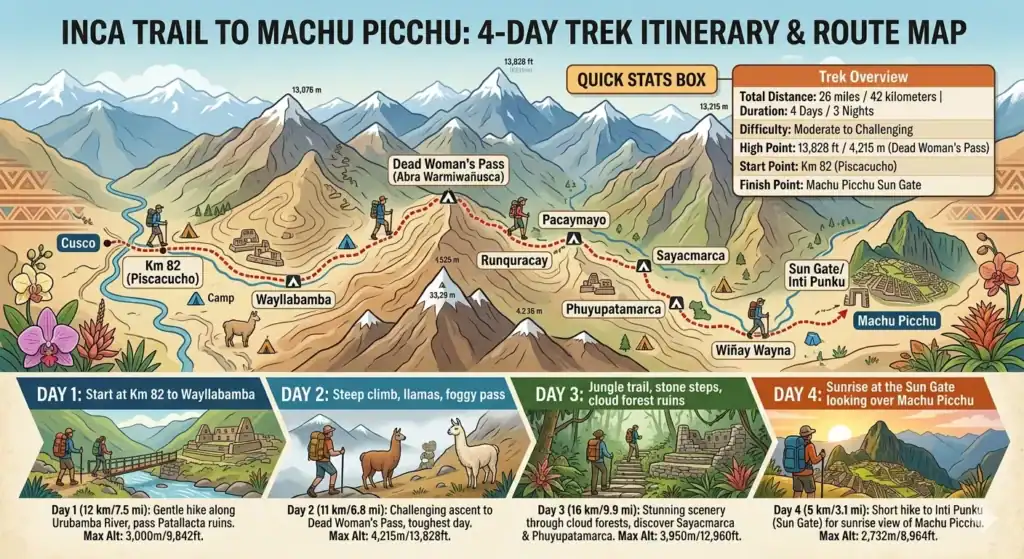
Over the course of four days, you will walk along original stone pathways built by the Incas more than 500 years ago. The geography changes drastically every day, shifting from dry Andean valleys and steep mountain passes to dense, mystical cloud forests filled with orchids and exotic birds. This rhythmic change in scenery is exactly what makes the inca trail from cusco one of the most famous trekking experiences in the world.
To help you visualize your upcoming adventure, here is the day-by-day breakdown of the terrain, distances, and landmarks you will encounter on the route:
- Day 1: Cusco to Wayllabamba (The Warm-Up)
Distance: 7.5 miles (12 km) | Hiking time: 5–6 hours | Max Altitude: 9,842 ft (3,000 m)
Your agency will pick you up early from your hotel in Cusco for a scenic drive to Km 82. This first day is relatively gentle, serving as a perfect training ground for your legs. You will hike alongside the rushing Urubamba River and catch your first glimpses of impressive Inca agricultural terraces at Patallacta before reaching the valley campsite of Wayllabamba. - Day 2: Wayllabamba to Pacaymayo (The Ultimate Challenge)
Distance: 6.8 miles (11 km) | Hiking time: 6–7 hours | Max Altitude: 13,828 ft (4,215 m)
This is universally known as the toughest day of the inca trail difficulty scale. You will face a continuous uphill climb through the Llullucha valley. The reward is reaching the famous Dead Woman’s Pass (Warmiwañusqa), the highest point of the entire trek. After celebrating at the summit with panoramic views of snow-capped peaks, you will descend steep stone steps into the Pacaymayo valley to sleep. - Day 3: Pacaymayo to Wiñay Wayna (The Most Beautiful Day)
Distance: 9.9 miles (16 km) | Hiking time: 8–9 hours | Max Altitude: 12,960 ft (3,950 m)
Although it is the longest day in terms of distance, it is visually spectacular. You will conquer a second, lower mountain pass and explore unique archaeological sites like Runkurakay, Sayacmarca, and Phuyupatamarca (the “Town in the Clouds”). As you descend into the Amazonian slope, the air becomes warmer and the vegetation turns lush. You will camp at Wiñay Wayna, right next to some of the most beautiful terraces on the route. - Day 4: Wiñay Wayna to Machu Picchu (The Grand Finale)
Distance: 3.1 miles (5 km) | Hiking time: 2 hours | Max Altitude: 8,964 ft (2,732 m)
An early morning wake-up call ensures you reach the Inti Punku (Sun Gate) just as the sun begins to rise. From this vantage point, you will get your very first, unforgettable panoramic view of Machu Picchu. After soaking in the view, you will walk down into the citadel for a fully guided tour of the ancient ruins before taking the train back to Cusco.
Inca Trail Difficulty: How Hard Is It Really?
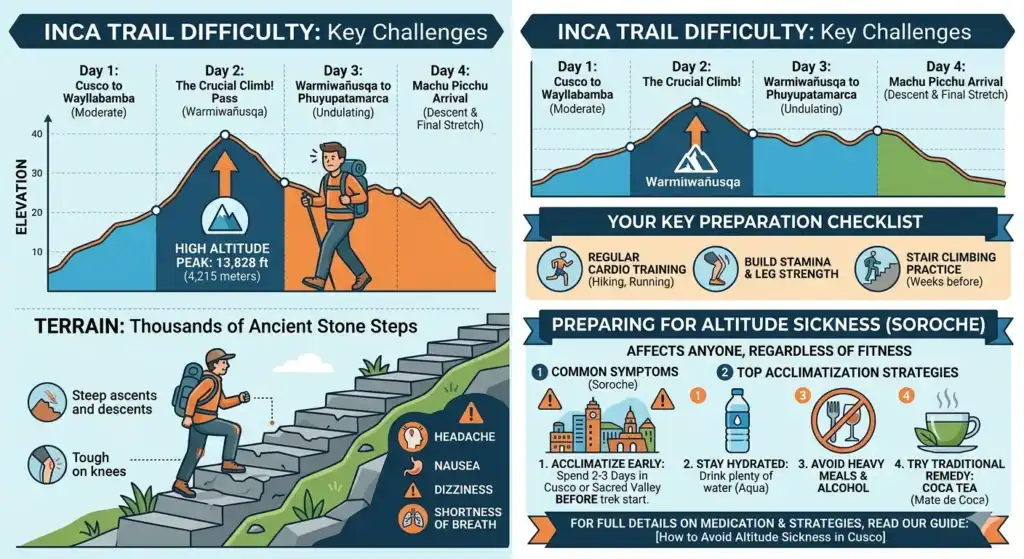
Evaluating the inca trail difficulty is crucial before stepping onto the path. This trek is generally classified as moderately challenging. You do not need to be a professional athlete, but you do need a decent level of physical fitness. The trail spans approximately 26 miles (42 km) over four days, but the real challenge is not the distance—it is the terrain and the elevation changes.
The trek features thousands of ancient, uneven stone steps that can be tough on your knees, especially during steep descents. The most demanding segment occurs on Day 2, where you will tackle a grueling uphill climb to Dead Woman’s Pass (Warmiwañusqa), the highest point of the route at 13,828 feet (4,215 meters). Regular cardio training, such as hiking, running, or stair climbing a few weeks before your trip, will make your classic machu picchu hike much more enjoyable.
Preparing for Altitude Sickness (Soroche)
One of the biggest concerns for hikers booking an inca trail from cusco tour is the elevation. Altitude sickness, locally known as soroche, can affect anyone regardless of their age or fitness level. Symptoms typically include headaches, nausea, dizziness, and shortness of breath.
To ensure your body adapts smoothly, we highly recommend spending at least 2 to 3 days acclimatizing in the city of Cusco or the Sacred Valley before starting your trek. During these days, drink plenty of water, avoid heavy meals or alcohol, and try the local traditional remedy: coca tea. If you want a complete breakdown of medical recommendations, medication, and acclimatization strategies, make sure to read our detailed guide on How to Avoid Altitude Sickness in Cusco
When is the Best Time to Hike the Inca Trail?
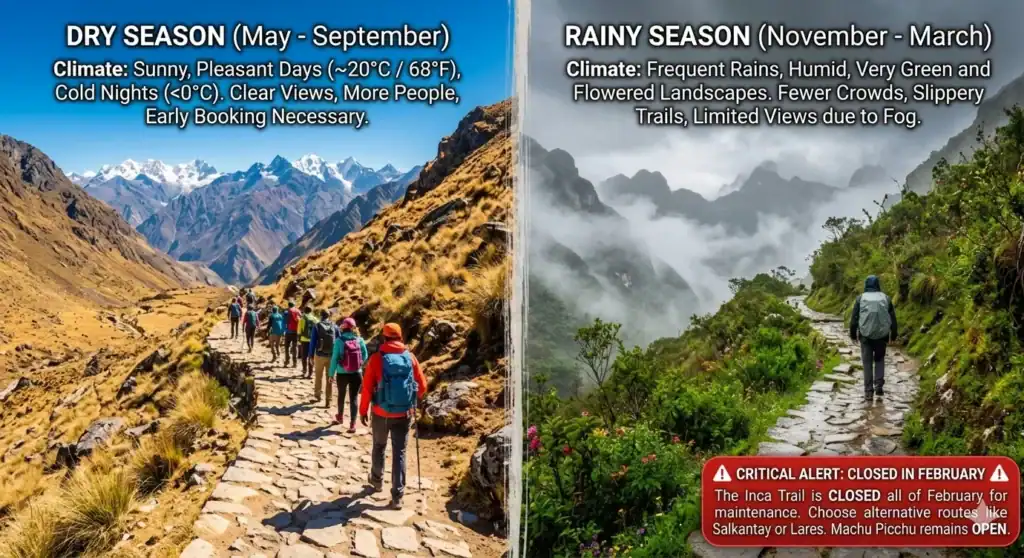
Choosing the right month for your adventure can completely change your experience. Generally, the best time to hike inca trail is during the dry season, which runs from May to September. During these months, days are sunny, rainfall is rare, and you will get clear, crisp panoramic views of the Andes mountains. However, this is also peak tourist season, meaning you must book your inca trail permits many months in advance.
To help you decide when to schedule your trip, the weather in the Cusco region is divided into two distinct periods:
- The Dry Season (May to September): This is the most popular time for a classic machu picchu hike. Daytime temperatures are pleasant, averaging around 68°F (20°C), making it perfect for walking. However, the nights can drop below freezing, especially at higher campsites like Wayllabamba or Pacaymayo. Be sure to pack high-quality thermal layers.
- The Rainy Season (November to March): During these months, rain showers are frequent and heavy. Trails can become slippery, and mountain passes are often covered in thick fog. The advantage is that the landscape turns incredibly green, flowers are in full bloom, and there are fewer crowds.
🚨 Critical Notice: The February Closure
If you are planning your trip, you must keep in mind that the Inca Trail is completely closed for the entire month of February. This annual closure is enforced by the Peruvian government to conduct environmental conservation, trail maintenance, and campsite repairs. While Machu Picchu itself remains open, no one can step onto the trail during February. If you want to trek in February, you will need to choose alternative routes like the Salkantay Trek or Lares Trek.
The Shoulder Months: A Hidden Sweet Spot
If you want to avoid both the massive crowds of the dry season and the heavy downpours of the rainy season, consider hiking during the shoulder months of April and October. During these transitional periods, the weather is highly unpredictable, but you often get a perfect balance of beautiful green landscapes, manageable weather, and shorter lines at the ruins.
How to Book Your Inca Trail Permits
Securing your inca trail permits is the most critical step of your travel planning. Unlike other treks in Peru where you can just turn up and start walking, the classic Inca Trail is strictly regulated by the Peruvian Ministry of Culture to protect the ancient pathway and its surrounding ecosystem.
You cannot purchase these permits independently; regulations require that you book through an officially licensed local tour operator. Here is the step-by-step breakdown of how the permitting system works and how to guarantee your spot:
- The 500-Permits-Per-Day Limit: The government only issues 500 permits per day for the classic machu picchu hike. However, this number is highly misleading. Out of those 500 permits, roughly 300 go to licensed guides, porters, and camp cooks. This means only about 200 permits per day are actually available for tourists worldwide.
- Book 4 to 6 Months in Advance: Due to the extreme scarcity of spaces, permits for the peak dry season (May through August) usually sell out within minutes of being released. To secure your preferred start date, you should book at least 4 to 6 months ahead.
- Passports Must Be Valid and Original: To book your permit, you must provide your exact legal name, date of birth, nationality, and current passport number. The Peruvian government checks these details at the trail checkpoints. If the information on your permit does not match your physical passport exactly, you will not be allowed on the trail. If you plan to renew your passport before the trip, you must book with your old passport number and update it with your agency later.
- Permits Are Strictly Non-Refundable and Non-Transferable: Once a permit is issued under your name, it cannot be changed to another date, nor can it be transferred to a friend or family member if you cancel. If you change your travel dates, your deposit will be lost, and a completely new permit must be purchased (subject to availability).
What to Do if Permits Are Sold Out?
If your dates are completely booked, do not panic. While you cannot hike the traditional trail, Machu Picchu remains accessible. You can easily pivot to incredible alternative routes that do not require restrictive permits and offer equally stunning scenery, such as the rugged Salkantay Trek, the cultural Lares Trek, or the adventurous Inca Jungle Trek.
Book Your Classic Machu Picchu Hike with Us
Ready to follow in the footsteps of the Incas? Planning an adventure like the inca trail from cusco requires attention to detail, experienced logistics, and a team that genuinely cares about your safety and experience. As an officially licensed local operator based right here in Cusco, we provide exceptional trekking services tailored to your adventure style.
Whether you are looking for a fun, camaraderie-filled small group tour or a premium, tailored private expedition, we handle everything from securing your competitive inca trail permits to providing high-quality camping gear and delicious, chef-prepared meals on the mountain. Our certified local guides are passionate experts in Inca history and are dedicated to helping you conquer mountain passes safely while respecting the local culture and environment.
Don’t let limited spaces ruin your dream trip to Peru. Spaces sell out quickly every season! Check our real-time Inca Trail 2026/2027 availability and secure your trek today!